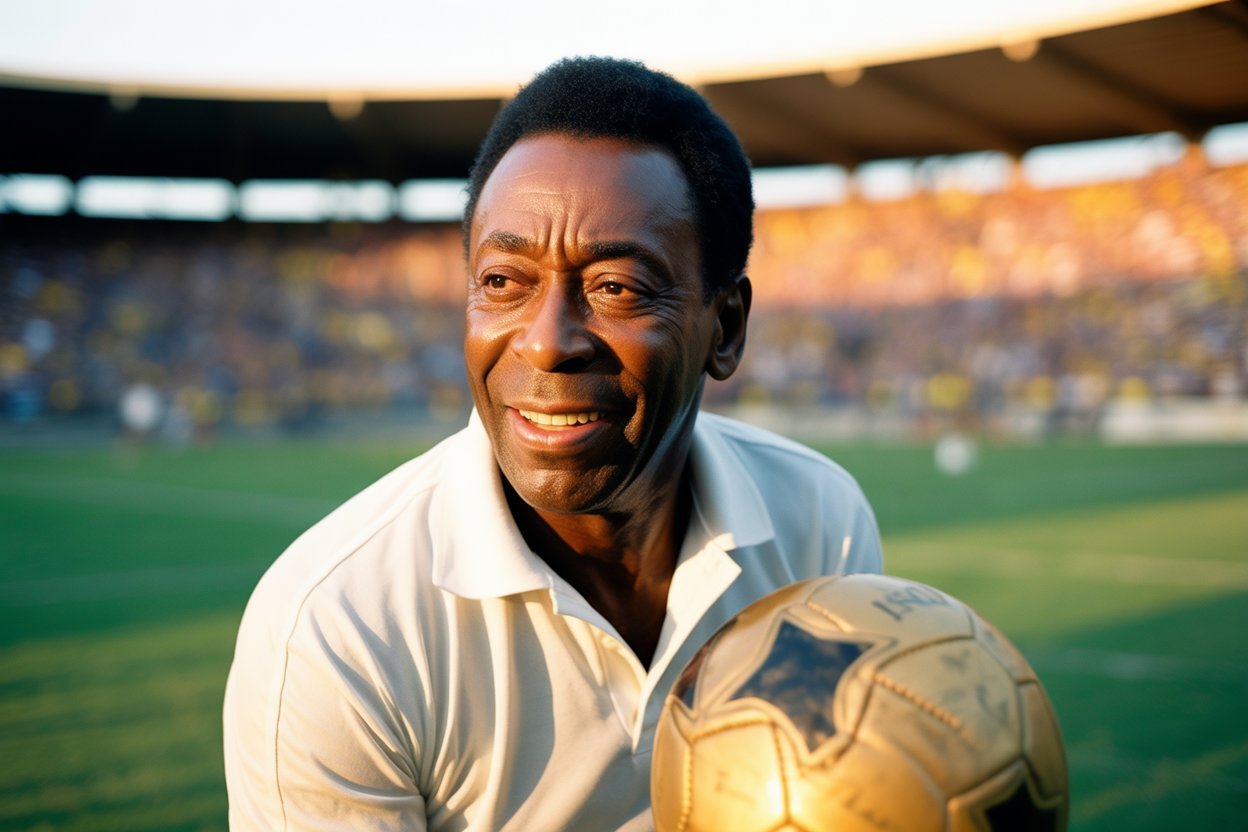
In the grand saga of football, there are a few names that shine through every era, and of those names, none shine bigger than Pele. Dubbed “The King of Football,” Pele transcended the title of player and was a global icon who carried both club and country to heights of glory that no one ever imagined would be possible. In this blog we will profile Pele’s remarkable journey: his legendary World Cup glory, brilliance at Santos FC, cultural impact in Brazil and around the world, and lastly, tell you exactly why he remains an immortal icon of football greatness.
Pelé and the Magic of Three World Cups
What sets Pele apart from everyone else in virally history is simple yet also unparalleled: three FIFA World Cup titles. At 17 years old in 1958, Pele stunned Sweden, scoring six goals, including two in the final, as he led his country to its first title. The sight of him tearfully overjoyed at the final whistle at the Maracanã became an iconic image of youth celebrating success.
Pele’s performances in 1962, even though injured, early in the tournament enabled Brazil to retain their title. In 1970 Pele scored four goals – a header in the final – while orchestrating what many call the best football team of all time.
His goal in the final cemented Brazil as the only country to have won a “three-peat” in World Cups, a record that has yet to be matched.
As of 2025, the reigning World Cup champion is Argentina, led by Lionel Messi – another giant historically compared to Pele who won the trophy in 2022.
Pelé and His Time at Santos FC: A Love Story with Football
Before the world of football was overrun by global superclubs, there was Santos Football Club and there was Pele. Pele took Santos at the age of 15, transforming a relatively small Brazilian club into a global brand. Pele scored more than a thousand goals for Santos between the years of 1956 and 1974, which allowed Santos to win two Copa Libertadores titles and two Intercontinental Cups, defeating European champions like Benfica and AC Milan in the process.
The current Copa Libertadores champions are Fluminense from Brazil, whose achievement mirrors those of Santos back in the day. However, the brand that Brazilian club football has today is down to pele’s brilliance several years ago.
Pelé and the 1970 Brazil Team: A Symphony of Football
The great pele was at the height of his power in the 1970 FIFA World Cup in Mexico. In terms of celebrating attacking football Brazil was a splendor of creative attacking football, with stars like Jairzinho, Tostado, Rivellino and at its center, pele.
He opened the World cup with a goal against Czechoslovakia, made an astonishing assist to his compatriot against Uruguay in the semi-final, and of course became legend when he opened the scoring in the final with a header. It was 4-1 to Brazil against Italy with pele lifting his third world cup, and still a record intact.
Brazil was flair personified, a team that showed teamwork and flair, and ultimately a freedom that set the precedent for ‘Jogo Bonito ‘the beautiful game’. Pele was at the heart of it all.
Pelé vs Maradona and Messi: A Debate That Never Ends
It is impossible to talk about football legends without mentioning Diego Maradona and Lionel Messi from Argentina. Both wore the number 10, like a pele. Maradona’s solitary moment of brilliance in 1986 and Messi’s record-breaking achievements make them legends.
But what keeps pele’s name forever present in all conversations is his total footballing profile: athleticism, agility, vision, strength, skill, and team success, at the very top level. Maradona and Messi have nothing over pele, who is still king of the world’s biggest stage, because he has won three World Cups.
It is now 2025 and Paris Saint-Germain are the UEFA Champions League title holders. They won their first-ever title, with a 5–0 thrashing of Borussia Dortmund in the final, underlining the evolution of modern football since pele’s time.
Pele’s Style: Poetry in Motion
Pelé was not simply concerned with scoring goals, but the way he scored his were over 1000. He scored goals in many ways; with powerful headers, dazzling dribbles, volleys, shots from distance, and delicate chips. He had a type of movement off the ball that was comparable to the way he played it.
Pelé possessed a rare combination of athleticism and artistry that has not been seen since. There was a rhythm and flow to watching pelé play that felt like watching a painter work. He was effortless with intent and quick with purpose.
He changed the game and in turn inspired generations of players; specifically Brazilian greats like Zico, Romário, Ronaldo Nazário, Ronaldinho, and now the torch has been passed to the likes of Neymar.
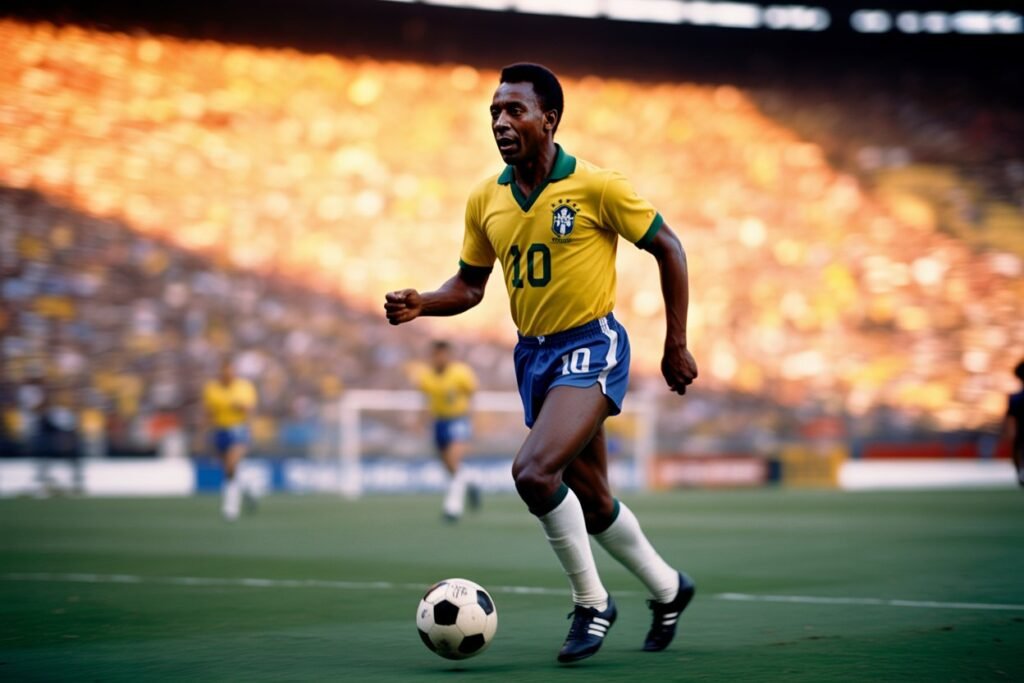
Pele’s Cultural Impact in Brazil and Beyond
In Brazil, pele was not just a football player, he was a national treasure. After the agony of losing the 1950 World Cup on home soil, Brazil began its healing process through pele’s brilliance in 1958.
Beyond Brazil, pele became football’s first true global ambassador. From exhibitions in countries who had hardly ever seen football played live, to signing with the New York Cosmos in 1975, pele brought the game to millions of people. His smile and joyful charisma had no boundaries of language as he introduced sport across the world.
Today, there are murals of pele on city walls in Rio de Janeiro and São Paulo, and documentaries, films, and books keep pele’s story alive for new generations.
Pelé and the New York Cosmos: Football Meets Hollywood
When pele joined the New York Cosmos, it was not just an opportunity to play football in the USA, it was about starting a cultural revolution. The stadiums were sold out, the stands were filled with celebrities, and the television channels were suddenly trying to get in on the action by showing soccer on the television, something that was rare for them to do.
During his time with the Cosmos, pele helped the team win the NASL championship in 1977 with record crowds. This time created an environment nearly two decades later where Major League Soccer could flourish, where we would have stars like David Beckham, Zlatan Ibrahimović and Lionel Messi.
As of 2025, the reigning CONCACAF Champions League winner is León (pending final confirmation), and we see that the football landscape in the Americas continues to grow and evolve.
Pelé Off the Pitch: The Man Beyond Football
Pele was a football legend, but he did more than that; he was the Minister of Sports for Brazil from 1995 to 1998 and used his status to assist in fighting corruption in the Brazilian football governance.
He was an ambassador for UNICEF and UNESCO and donated much of his time supporting children’s health, education, and sports programs across the globe. Pele was an accomplished author and autobiography writer as well as actor in films and recorded songs. He demonstrated his creativity beyond the football pitch or soccer field.
Throughout everything he retained his humble and gentle humor self. Despite the debate of “the greatest” he remained loved by all things and people related to football.
Pelé’s Passing and an Era’s End
In December 2022, the world said goodbye to a football legend when Pele died at 82. Tributes came in from all corners of the globe: social media was flooded with tributes; stadiums recognized Pele by taking a moment of silence; Brazil declared three days of national mourning, much like what Argentina did with Maradona in 2020.
Fans in Santos waited for hours to pay their last respects to Pele’s coffin at Vila Belmiro stadium. His funeral showed that Pele’s magic persists decades after playing his last ever professional game.
Pelé’s Eternal Legacy:
Why does pele remain relevant? Because he exemplified football’s strongest universal yearning: talent and joy can break the chains of poverty and provide hope for millions.
From a barefoot child juggling a grapefruit on a street lot in Brazil to having three World Cup medals hanging around his neck, pele illustrated the possible. He was a baseline for forwards, he was a national inspiration, he was an iconic figure who made the entire world fall in love with football.
Even in 2025, Pele is known by new generations of every nationality through pixelated video clips and oral history. His name evokes, not merely goals, but a way of thinking: the way to play football beautifully, without fear, and with joy.
Conclusion:
While there are many legends in the sport of football, Pelé’s status among legends sets him apart both on and off the field. His records, his artistry, and most importantly, his essence remains and continues to inspire. In an age of football that now acknowledges clubs such as Paris Saint-Germain in Europe, Fluminense’s in South America and Urawa Red Diamonds, Pelé serves as a clarification of what football really is: passion, elegance and solidarity. He was not just a player; he was a trailblazer, a national hero, a worldwide ambassador. He taught us that football is not only about winning, but how you win, how you dream, inspired others to dream. In each goal, every child balancing a ball, and every roar in the stands, there is Pele’s spirit alive and well the King of Football.
About The Author