In football, putting together an effective strategy for a winning game plan encompasses more than skill-it is strategies. Coaches will repeat “it was tactics, tactics, tactics”, and there are dozens of formations and tactics to choose from. For example, Marcelo Bielsa said he once studied “29 possible formations” for 1 team. In this document we will outline the basic formation strategies (4-4-2, 4-3-3) or playing strategies (high pressing, tiki-taka possession, counterattacks, or defensive blocks), and how they determine when teams will possess or take up a deep defensive position. As an example, coaches sometimes find themselves in a position where they need to high-press (high-press strategy) because they are behind, then switch to being counterattacking once ahead which demonstrates that tactics can be dynamic during a game.
Formation Strategies: 4-4-2, 4-3-3, and 4-2-3-1
A team’s formation is its starting lineup on the pitch. Classic formations are 4-4-2 (four defenders, four midfielders, and two forwards) or 4-3-3 (four defenders, three midfielders, and three forwards). Formation helps establish the basis for tactical approaches. In the old-style 4-4-2, defenders defended, and full backs would cover the winger, while the two midfielders (a defensive and attacking) would play flat. This simplistic formation was common just 10 years ago. However, many coaches now prefer variations including 4-2-3-1 (two holding mids and three attacking mids) and even 3-5-2 for extra midfield numbers. For example, both Barcelona and Real Madrid employ a 433 alignment, and have three attackers to stretch opposing defenses. Further, teams can change formations during the game (ex. in a 4-4-2 diamond) and adjust, demonstrating that formations and strategies are fluid.
High-Press Strategies: Intense Defense in Attack
A high-press style applies defense as an offensive strategy. A high-press team pushes defenders and midfielders to high up the pitch to win the ball faster. FIFA defines high press as “an attacking tactic where a team defends in an advanced position on the pitch, with their backline often just inside their opponents’ half.” The objective is to regain possession in the opponents’ final third and disrupt their build-up play. Tottenham Hotspur under Mauricio Pochettino offers one example of a high-pressing approach to compress space. Tottenham’s backline played an extraordinarily high defensive line, and the team was able to force many errors in dangerous areas. Jurgen Klopp’s Liverpool FC takes this even further with gegenpressing, which is the practice of hunting the ball immediately after losing it. This intense approach has led to many trophies, including the Champions League in 2019 and Premier League title in 2020. However, FIFA warns that excessive, unstructured pressing can have a counterproductive effect, saying “if the press is not cohesive and structured space opens up” for the opponents.
Tiki-Taka Strategies: Possession and Passing
Possession-based Strategies
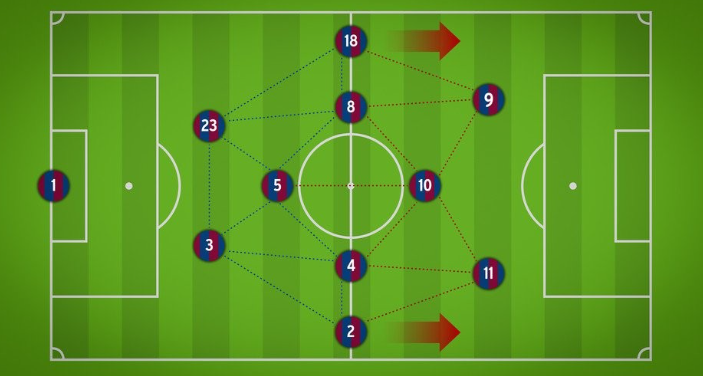
Concentrating on keeping the ball, controlling the game’s tempo. The most well-known is tiki-taka, a short-passing philosophy of play predicated on patience and movement. FIFA refers to the definition in its new laws of the game; Tiki-Taka is “a possession-based philosophy of football made famous by the Spanish national teams who won World Cup 2010 and Euro 2008 and 2012.” Essentially, a tiki-taka team maintains the ball, deploying technical skill and fluid positioning to penetrate defenses. Analysts say Barcelona’s era of tiki-taka showed “possession football was the way forward”. Teams like this move the ball with quick, one-touch passes until an opening appears. Of course, this strategy can struggle if opponents simply defend deep; too many short passes without penetration wastes effort. But when it works (as with Barcelona/Spain 2008–2012), the dominant side often overwhelms opponents with constant control
Counterattack Strategies: Quick Transitions
A counterattack strategy is almost a complete opposite of tiki-taka. Rather than control the ball, teams invite attacking pressure only to attack quickly at the turnover of possession. After a team has let the encounter attack from off, players charge forward into the spaces created during the opponent’s attempt to attack. ESPN highlighted this with lowly ranked Premier League teams: West Ham, Leicester City, and Crystal Palace were all “great on the counterattack” while they had low possession overall. These lower teams invited the stronger teams to own the ball, then struck them with quick breaks (often using flying wingers and quick strikers). This yielded some historic wins – for instance, in 2016 the champion Leicester City title run was premised on catching big teams off the turnover in possession. Commentators reiterated that counterattack often worked best when the inferior team was playing away from home – “less pressure to entertain”. In summary, a counterattack strategy seeks to move rapidly from defense into attack, and under special circumstances it does work and help to “solve” possession-based teams (even José Mourinho’s squads beat Barcelona in 2009 this way).
Defensive Line Strategies: High Line vs. Low Block
Defensive tactics also have to do with how high or low the back line plays. High defensive line means defenders are up around the midfield to help them with the press by compressing the field. The caveat to a high line the analysis mentions is that “it leaves considerable space behind Ryan.” A low block (deep line) has defenders near the penalty area to reduce space. The guide cites, “a low block is when teams drop back into their own defensive third and reduce the space available” for the opponent. Italy´s renowned catenaccio game style is an example of this. Defenders would create a low block and “let teams forward,” to then counter quickly. In practice, teams can often utilize both blocks: a coach may implement a high press, chasing another goal, then when defending a lead, retreat into a low block.
Example Strategies from Top Teams
- Barcelona (Spain): Mastered possession strategies. Under Pep Guardiola they played 4-3-3 with the famous tiki-taka short passing. FIFA notes their style was “possession-based,” and analysts say Barcelona’s era proved possession football could dominate.
- Liverpool (England): Is the high press. They play a 4-3-3 under Jürgen Klopp and use an aggressive version of gegenpressing. The moment they lose the ball; they look to immediately find their man. This continued pressure consistently gets their highest quality players the best chances in front of goal, which is how they won the 2019 Champions League and the 2020 Premier League.
- Leicester City (England): Premier League champions in 2016 with a counterattack-focused 4-4-2. The team ceded possession to stronger rivals but scored on quick transitions , a classic counter strategy
- Real Madrid (Spain): A versatile 4-3-3 team that excels in rapid transitions in play. However, in major matches (such as a Champions League finals), they typically adopt a low block and counter quickly with direct attackers. An excellent example of their counter attacking nature was in their 2018 title win where the counter attacking movement was rapid.
- Italy (national team): Use a deep-block defense (catenaccio) and lethal counters and Italy’s world cup title in 2006 was built on a disciplined low block and effective counter attacks.
- Key Takeaway: Formations provide the structure, but the coach must decide the right combination of tactical strategies. Teams will use attacking strategies (like pressing or possession play) and defensive strategies (like a low block or counter) according to their players and the game context. The best teams (a case in point is Barcelona in 2010) are characterized by possession, pressing hard and recovering possession quickly, and modern teams create primaries plans A and B in training for both their possession and recovery play. For any novice, this is important to understand to enjoy analyzing the match.
About The Author